
How not to open a restaurant!
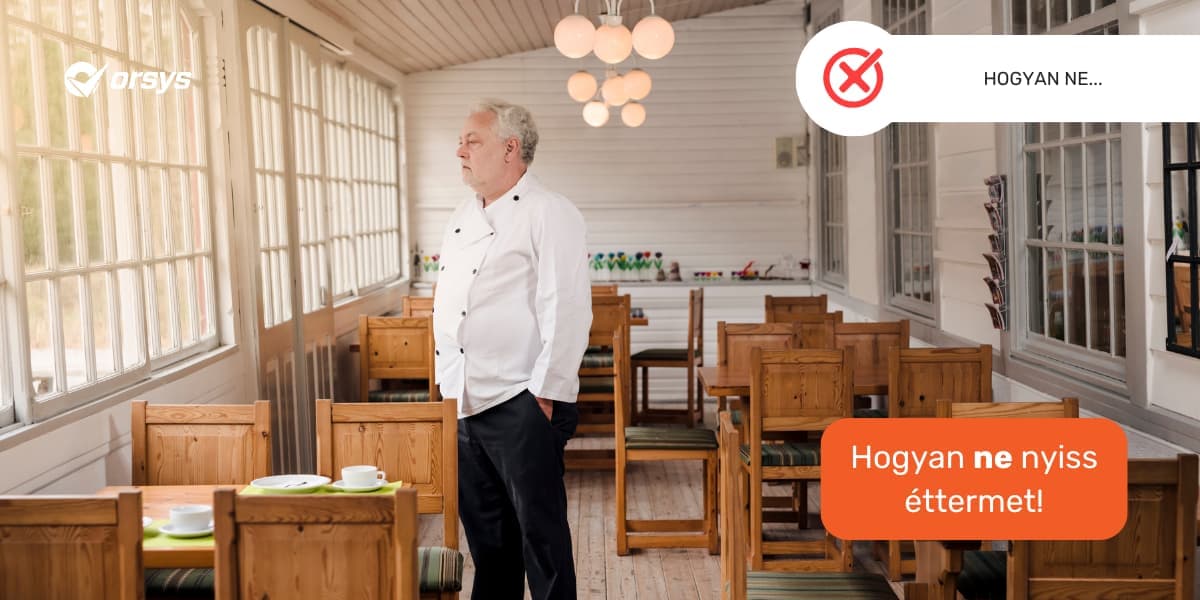
Countless articles describe the perfect restaurant model, flawless marketing and valued colleagues who love their profession. You read them and immediately feel that you can do it too! You will only encounter the real pitfalls in real life, and make no mistake, some will be frightening. Of course, you must never give up! Knowledge and determination alone will not be enough. Luck plays a bigger part than anyone likes to admit!
In this new series, we want to show the biggest pitfalls of opening and running a restaurant step by step. Rather than repeat what you should do, we will emphasise what to avoid. For the first part of our "How not to..." series, we examine the most common problems. There will be subjective views, but every line comes from experience, and our story is based on real events.
The foundations:
1.) There are two types of successful restaurant owner:
-The first has plenty of money and can afford to learn along the way.
Someone with unlimited capital waiting to be invested may be more fortunate, but money alone has never run a restaurant.
-The second is an industry professional.
Being able to act as kitchen manager, business manager or head waiter yourself can save your life and your restaurant. Administration and marketing are also responsibilities that must be assigned at the outset. The more of these you understand, the more successful you can be. Of course, I would warn anyone against becoming the boss who interferes in everything. Simply be good at something and set an example in it for those around you.
The idea that we can hire someone for everything we do not understand is idealistic. That is how it should work, of course, but outsourcing every responsibility can be expensive.
2.) Choose the location carefully!
Market research, whether you conduct it yourself or hear it from others, always leans towards optimism. The weeks before a dream comes true instinctively make reality look brighter. Hope always adds colour! At this point, the most important thing is to make unemotional, hopefully sound decisions.
3.) The necessary permits!
Everything needed for opening, from official permits to suppliers, costs more and takes longer than you initially expect. Each task takes only a few days, but most depend on others, and small delays add up. A sufficiently pessimistic deadline is essential. Take time to understand every detail. Ask twice if something is unclear, because the next explanation may come only when you are already in trouble.
4.) Create the interior you imagined!
Holding to your envisioned concept is good, but external circumstances and the premises themselves may bring surprises that require a response. Allow for overspending and, at best, a few days' delay here too.
5.) Do the maths!
A forint you can turn into four is good. Turning it into three is still acceptable. Anything below that means losses and a direct route to bankruptcy!
Even the most precise calculations sometimes underestimate incidental costs. Cling film in the kitchen, date labels, pens, washing-up liquid and bin bags are little things you also use at home that cost next to nothing. But not in your restaurant! Every HUF 1,000 spent daily becomes thirty times that by the end of the month. Do not underestimate these costs. What you overlook could equal a whole month's fuel bill.
6.) The team!
Never promise too much in advance or discuss distant ambitions, because they will become expectations. If you fail to deliver something, your reputation suffers and employees lose enthusiasm. I am not talking about military discipline, but anyone you let walk all over you will keep doing so until you part ways.
You have found the perfect location, have a business plan and a frighteningly good team. Your marketer promises the moon, you have hopeful determination and world-changing ideas, and plenty of people encourage you because "it'll be great"!
Then let's open!
Expected results:
Once you have a concept you feel comfortable with, you just need to attract guests. The right marketing can get any guest through the door once, but only regular returners will make money for you. If a guest enjoys the food, drinks and service, they smile, leave a generous tip and make you hope they will return tomorrow. They usually will not, except perhaps a few percent. This does not necessarily mean you did anything wrong. There is so much competition and so much vying for guests' attention that another restaurant's marketing will draw them away, then another, and so on. If you target only passing trade, business will be erratic. You cannot predict whether the evening will begin with a full house or an empty room. Without regulars, only hotels and holiday areas remain profitable. Consider that when investing.
Quality and dedication are essential. We have read that a million times, and it is true, but nobody has a perfect recipe for running a restaurant. An even greater truth is that crowds attract crowds! More important than any advertisement, uniqueness or curiosity is your ability to fill the dining room. Getting the first 2–3 tables seated is worth every effort! It is sad to write, but from then on people look less at what they will get and more at getting what everyone else wants. Even bad food seems much tastier when 20 other people around us are eating it.
Every restaurant is unique, and each has only one key to success. Only the owner can find it. Everyone else gives advice influenced by their own interests.
Now for a personal account, 12 months in 12 sentences. It is not representative, but it describes how most businesses operate quite well:
- Month 1: You finally open, and as reading comments each morning becomes routine, you are certain all your dreams will come true and the whole world has been waiting for you!
- Month 2: It is not as easy as I thought, but we have several months of reserves. Business will pick up once the neighbourhood gets to know us!
- Month 3: Some things need rethinking, the first compromises arrive, and we must admit that the market shapes the offering!
- Month 4: I earned two forints, so we celebrate with a crate of sparkling wine and everyone who has ever been near the restaurant!
- Month 5: The numbers do not work. We need more profit to survive!
- Month 6: I am exhausted. When can we finally take a holiday? I spend so much time away that my child barely recognises me!
- Month 7: Guests now seek us out specifically. The marketing works, and we must be doing something right!
- Month 8: Although half the original team has changed, things are coming together and we worry less about consuming our reserves.
- Month 9: We still need more profit and have had to inject more money we do not have into the business.
- Month 10: You begin to see the business for what it is, with a realistic view of its potential.
- Month 11: Another wave of depression hits. You realise you are not where you wanted to be and look for faults in yourself!
- Month 12: In the alcohol-fuelled haze of the birthday party, you can finally show a real profit, or you have closed for good!
Statistics suggest that only one restaurant in three achieves real success, while two close before their second birthday. The most important question is what not to do, because what others do well may not work for you. Learn from other people's failures. Copying a successful business guarantees nothing.
We wish everyone a successful, happy restaurant opening. Hospitality is a wonderful profession, and there is no doubt that we are needed!
Written by Tamás Kállay
Last updated:
Do you need professional software?
Try it without commitment and request our free demo.
- Simple to use and quick to learn,
- Professional solutions for every size,
- Saves time and energy for you and your team.